Four real estate accounts. Four different ways of proving the ad spend worked.
A real estate closing cycle typically runs 3-6 months from first inquiry to signed deal — sometimes longer. A campaign report that only shows week-two lead volume is answering the wrong question. These four accounts (names withheld per client confidentiality agreements) show what it actually takes to run Meta ads on a property that won't close for months: language-matched creative, conversation over forms, CRM-linked proof of purchase, and a funnel that doesn't need a large budget to cover both ends of buyer intent.
We’re the marketing strategists behind the brands you love











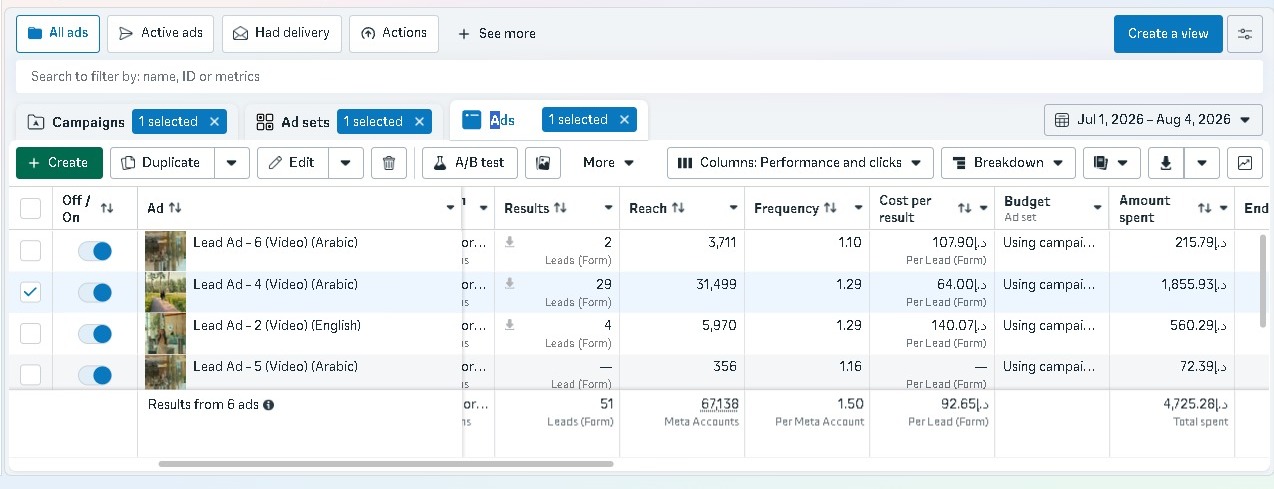
This developer needed one campaign to work for two audiences at once — English-speaking and Arabic-speaking buyers, both shopping the same off-plan units. Rather than run one generic version and hope, the account split six video lead ads across both languages and let the results settle the argument.
They didn't settle it evenly. One Arabic-language ad alone pulled 29 leads from 31,499 people reached at 64.00 AED per lead. The English variant, shown to a similar-sized audience, returned just 4 leads at 140.07 AED per lead — more than double the cost, for a fraction of the volume. Across all six ads over five weeks, the account closed at a blended 92.65 AED (roughly $25) per lead on 4,725.28 AED total spend.
The lesson wasn't "Arabic outperforms English" as some universal rule — it's that in a bilingual market, language-matched creative isn't a polish step, it's the variable that decides whether the budget behaves like a lead engine or an expensive experiment.
This brokerage made a specific bet: that a live conversation qualifies a real estate buyer better than a static form ever could. Instead of running lead-form ads, they ran Click-to-Messenger campaigns, so every response opened a conversation rather than dropping a name and number into a spreadsheet.
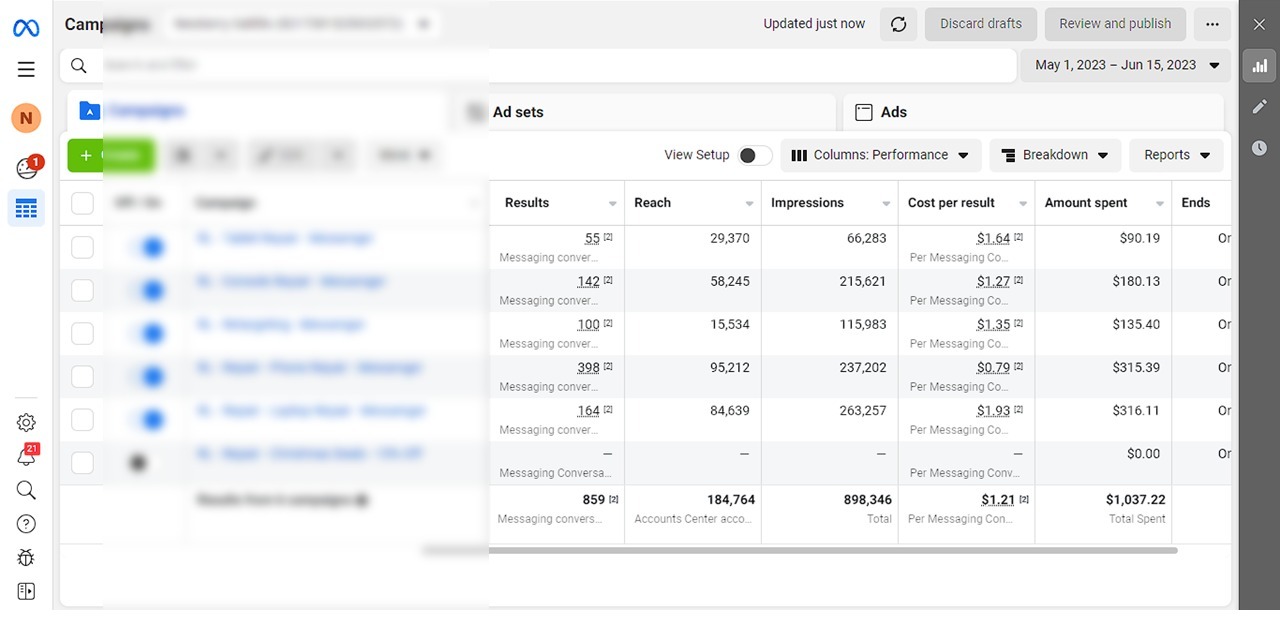
Over six weeks, the account generated 859 messaging conversations from roughly 898,000 impressions and 184,764 people reached, at a blended $1.21 per conversation on $1,037.22 total spend. The strongest ad set in that window brought conversations in at $0.79 each; even the weakest held under $2.
It's the same principle we discussed with Sara and Amani about landing pages versus native forms, taken one step further: a conversation starter lets a prospect ask the one question that actually decides whether they're serious — "is this still available at that price?" — and a form field never gets to ask that back.
Every real estate account eventually gets asked the hard question: does any of this actually turn into a sold unit, months from now? Most can't answer it, because the ad platform only ever sees the lead, never the close. This account could answer it, because every deal that closed in the CRM was fed back to Meta as an offline conversion.
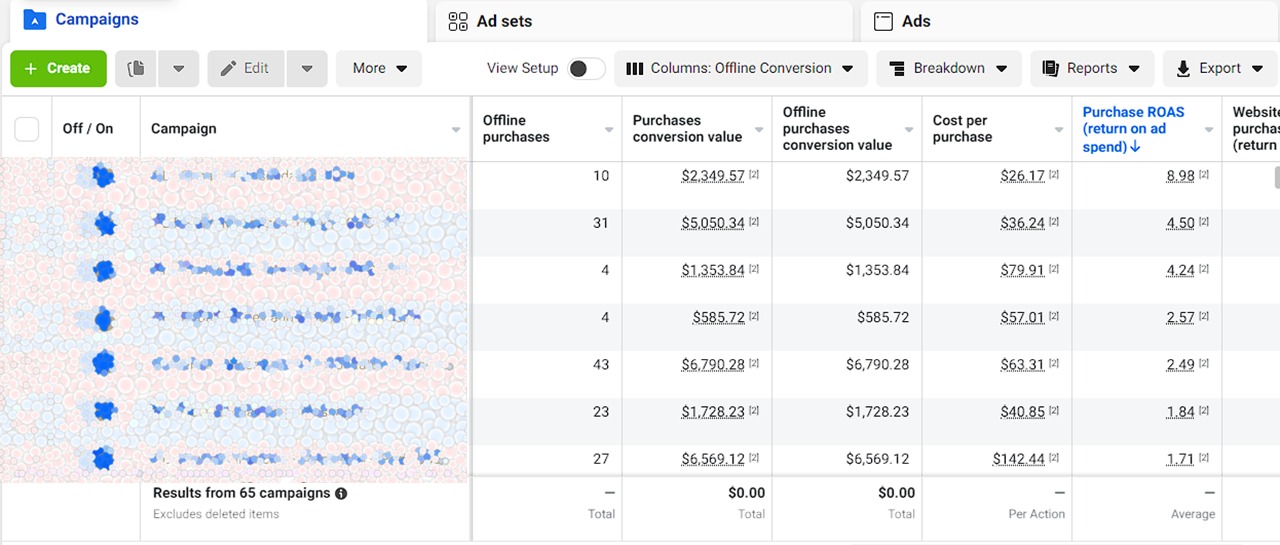
That closed the loop between ad spend and actual sales. Across 65 active campaigns, purchase ROAS ranged from 1.71x up to 8.98x depending on the campaign — with one campaign alone converting 43 offline purchases worth $6,790.28 in tracked value at just $63.31 per purchase.
This is what "optimize toward CRM outcomes, not raw leads" looks like once it's actually running: budget stops chasing whichever campaign produces the cheapest clicks and starts following whichever campaign produces buyers — even when the buyer doesn't sign until months after the click.
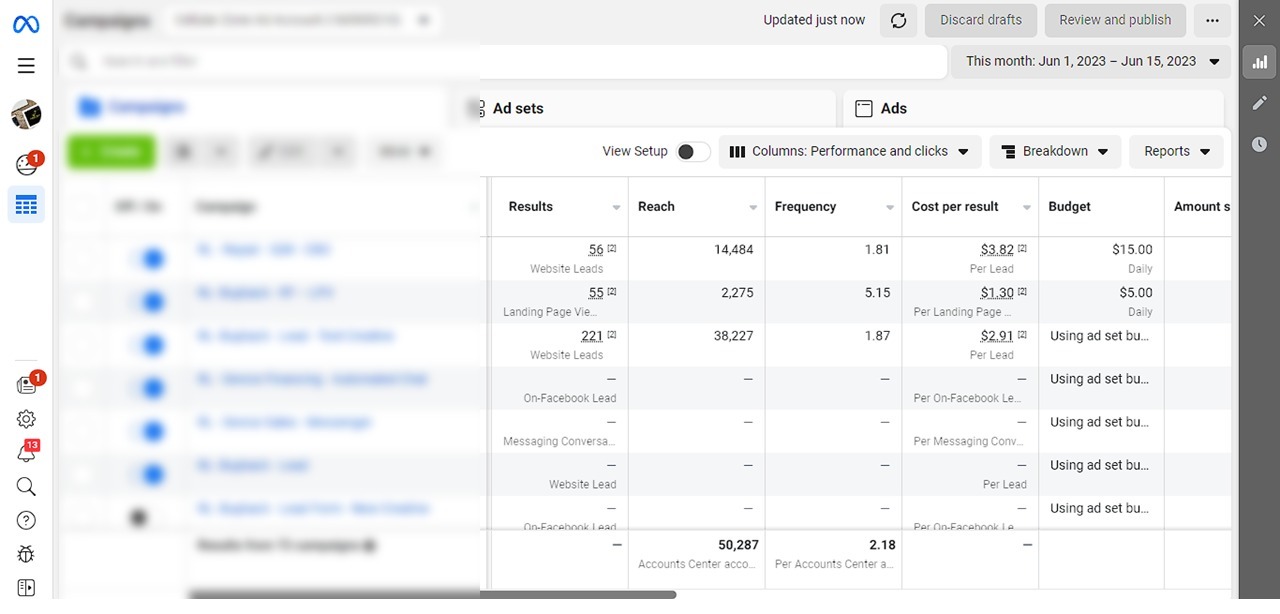
Not every account needs a large budget to run a layered strategy. This one split a modest daily spend — $15/day toward lead generation, $5/day toward landing page views — across two intent types running side by side in the same account: a website-lead form for people ready to talk price, and messaging for people who just had a question.
In a two-week window, the lead side alone produced 221 website leads at $2.91 per lead from 38,227 people reached, alongside a broader awareness push returning 56 leads at $3.82. In the adjoining month, the messaging side of the same account generated as many as 329 conversations at $1.24 each, with link clicks running as low as $0.08.
Neither channel had to carry the whole account. Measured separately and left alone otherwise, a small budget covered both ends of intent without either one drowning out the other.
None of these accounts were judged on lead volume alone.
Four different accounts, four different tactics — bilingual creative, Messenger conversations, CRM-linked offline conversions, a layered low-budget funnel — but the same underlying discipline: none of them treated a cheap lead as the finish line. Real estate's 3-6 month closing cycle makes that non-negotiable. A lead that looks efficient in week two and never gets nurtured, qualified, or tracked through to a signed deal isn't proof of anything — it's just a number that happened to be small.
The accounts that could prove ROI were the ones built to survive the gap between the click and the close — whether that meant matching creative to the language a buyer actually thinks in, letting a conversation replace a form, or feeding closed deals back into the ad platform months after the lead first came in.
Schedule a 30-min strategy session.
Bring your accounts, your numbers, and your goals. We'll come back with an honest read on what we'd change in the first 30 days.